At Superior Flight School, all pilots going through our Part 141 and Part 61 training programs take an Additional Aircraft Multi-Engine Course and Multi-Engine Instructor (MEI) Course. While FAA requirements do not explicitly require multi-engine to obtain an ATP license, airlines will require any pilots operating multi-engine aircraft to have it.
In other words, commercial airline pilots need multi-engine to fly anything beyond a single-engine aircraft typically only used for short-haul or commuter flights. By training all student pilots through our multi-engine courses, we set our pilots up for success beyond flight school.
Overview and Requirements
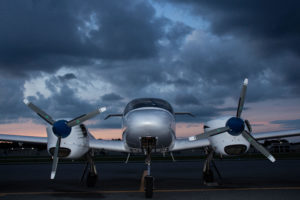
Multi-engine is an additional rating pilots can obtain that allows them to fly an aircraft with more than one engine. It requires specialized flight training beyond the single-engine planes typically used in flight school, such as the Cessna 172 Skyhawk.
In a multi-engine course, student pilots learn advanced aerodynamics, complex aircraft systems, and emergency procedures unique to larger aircraft. This best prepares students for careers working for airlines, where almost all passenger planes they will operate are multi-engine.
Through both our Part 141 and Part 61 flight training programs, our students must have at least a Private Pilot License (PPL) or Commercial Pilot License (CPL). Students receive a minimum of 15 flight hours in our dual-engine Piper Seneca (PA-34) and a minimum of 15 hours in ground school. A flight exam is also required to complete the multi-engine course.
Accelerated Course
Accelerated courses, also known as fast track flight training courses, allow students to get through flight school at a quicker pace through a more intensive program. A multi-engine accelerated course takes 1 month on average to go through in comparison to the 1.5 months through a standard flight training program.
Because accelerated flight training follows a Part 141 curriculum, the requirements for the multi-engine course remain the same. However, students undergo a more intensive and immersive program, requiring them to complete hours of training in a shorter period of time.
Rating Course
The multi-engine rating course is the main multi-engine training course for pilots. This allows them to operate an aircraft with more than one engine. Most larger planes have more than one engine. This includes the Boeing 737 and Airbus A320, both twin-engine planes used in commercial flights.
This rating course requires checkrides and an exam for students to showcase their proficiency in operating an aircraft with more than one engine. For the cost of our programs that include the multi-engine course, contact us directly.
Multi-Engine Instructor (MEI) Course
The multi-engine instructor (MEI) course is also covered in our Part 61 and Part 141 programs, as well as our accelerated flight training program. This allows certified flight instructors (CFIs) to teach student pilots how to operate a multi-engine aircraft. Completing the MEI is another way for pilots to work while obtaining the extensive flight hours needed towards an Airline Transport Pilot (ATP) license.
Students taking the MEI course must have a Commercial Multi-Engine License as a pre-requisite. To complete the course, they must have a minimum of 25 hours of Dual PA-34 flight time, 20 hours of oral single engine, and 40 hours of ground school. Both a written exam and flight exam are used to prove the student’s proficiency in order to complete the course.
Are you interested in learning more about Superior Flight School? Contact their Admissions Team for more information at admin@superiorflight.com