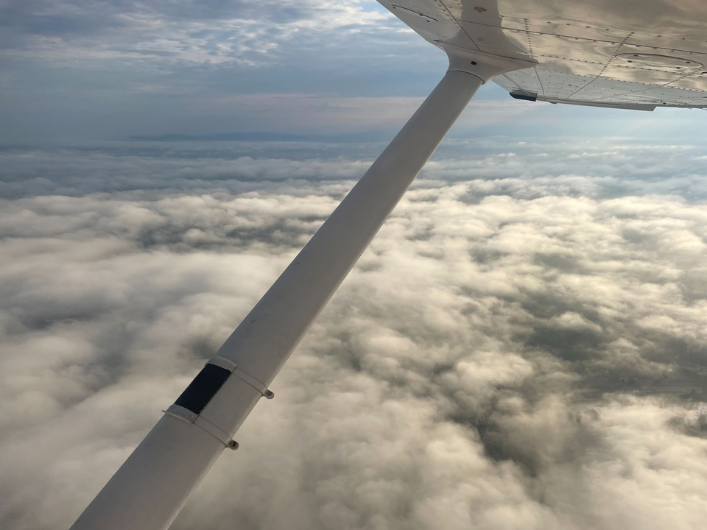
Student pilots flying solo must adhere to stricter VFR weather minimums, specifically maintaining visual contact with the ground during training. In addition to the weather minimums set by the FAA, some flight schools also have their own standard for weather minimums, which must be at least as strict, or stricter, than the FAA’s.
Basic VFR weather minimums are determined by airspace class, determining distance from clouds and flight visibility.
What Are Weather Minimums?
Weather minimums are used to determine the exact minimum ceiling and visibility pilots must comply with during flight in a given airspace.
Basic VFR (visual flight rules) minimums require the following statue miles for pilots:
- Class A: restricted, not applicable
- Class B-E: 3 statute miles
Pilots must also maintain a minimum distance from clouds for each airspace:
- Class B: clear from clouds
- Class C-E: 500 feet below, 1,000 ft. above, 2,000 feet horizontal
But, for student pilots, the requirements are stricter. Student pilots must always maintain surface visibility of at least 3 statute miles during daylight hours and 5 statute miles during the night time, according to FAA 14 CFR section 61.89(a) (6). Students can only fly solo when the flight allows for visual reference to the ground, as stated in FAA 14 CFR section 61.89(a) (7).
Why Weather Minimums Matter for Student Pilots
Weather minimums are essential for student pilots to understand in order to ensure the safety of themselves and others in any given airspace. Students fly solo during ideal weather conditions so that the weather does not limit spatial awareness and force students to handle unexpected weather with poor visibility to the ground.
Georgia is home to the world’s busiest airport: Hartsfield-Jackson Atlanta International Airport. Students who go through flight training must share the airspace with commercial planes, cargo planes, and other aircraft, making weather minimums critical to follow. Stricter weather minimums for student pilots exist so that reduced visibility doesn’t just impact the student, but every other aircraft in the surrounding space. When a student pilot is caught in poor weather conditions near a high-traffic airspace, there are fewer options. With less experience to draw on, there is less room for error.
Building a habit of adhering to weather minimums early on separates pilots who fly with confidence throughout their career from those who find themselves in situations they were unprepared for.
Common Weather Conditions That Affect Student Pilots
Because student pilot certificates only allow students to make solo flights when the flight allows for visual reference to the ground, there are common weather conditions that can impact training.
Students are restricted from flying solo if weather conditions are not ideal enough to use VFR. This includes flying solo during:
- Thunderstorms
- Dense, low fog
- Rapidly shifting winds/fronts
Student pilots training in the state of Georgia benefit from ideal and consistent weather conditions compared to many other states offering flight schools in the U.S.
Flight School Weather Policies
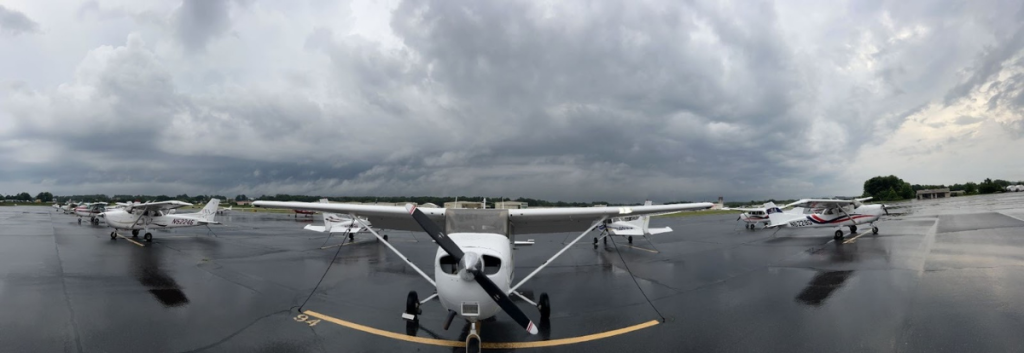
As with any flight school, Superior Flight School has requirements when it comes to the weather to ensure the safety of all students and instructors throughout flight training. Where the FAA may allow student pilots to fly under certain conditions, a flight school may decide to ground students entirely, as they have a greater understanding of their local environment and the policies crucial to protecting the safety of students during solo flights.
Being only a half hour from Atlanta, Georgia, student pilots at Superior Flight School gain experience in a busier airspace in the U.S. So, weather requirements must reflect that as well. When poor weather conditions are present, there is a ripple effect. Flights at Hartsfield-Jackson Atlanta International Airport may experience delays, shifts in traffic patterns, and changes to the density of air traffic. Superior Flight School prepares for this so that students are always flying in a safe environment while gaining the experience they will need throughout their career as a commercial pilot.
Learning to Make Go/No-Go Decisions
A go/no-go decision is a skill that a commercial pilot uses throughout their career to evaluate current conditions and make a critical decision to either continue on their current flight path or divert course. Student pilots learn to do this in accompaniment with basic training skills such as checking METARs and TAFs, understanding weather minimums they must follow, and knowing their own personal minimums relative to what the flight school and FAA allow for.
Superior Flight School trains student pilots to prepare to make go/no-go decisions in their commercial pilot careers with confidence through extensive ground school and in-flight training, both in Part 141 courses and Part 61 courses.