
The FAA requires all pilots to hold a valid medical certificate before acting as pilot-in-command or as a required crew member on an aircraft. A medical certificate confirms that a pilot meets the physical and mental health standards set by the FAA to safely operate an aircraft. The class of medical certificate a pilot needs depends on the type of flying they plan to do.
Getting a medical certificate involves two steps: completing FAA Form 8500-8 through the MedXPress online portal and passing an in-person exam with an Aviation Medical Examiner (AME). Understanding what each step involves helps student pilots and aspiring commercial pilots prepare for the process.
Complete the FAA MedXPress Form 8500-8
Before scheduling an appointment with an AME, pilots must complete FAA Form 8500-8 through the FAA MedXPress portal at medxpress.faa.gov. MedXPress is the FAA’s online application system designed to streamline the certification process and reduce the amount of time spent at the AME’s office.
First-time users create an account using a valid email address, which also serves as the login. The form asks for personal information, total flight hours, the date of the last FAA medical exam, current medications, and a complete medical history. Every question on the form requires an honest and thorough answer. The FAA takes intentional falsification seriously. Omitting a condition or medication from the application can result in suspension or revocation of all pilot certificates and ratings.
After submitting the form, the system generates an eight-digit confirmation number. Pilots must bring that confirmation number to their AME appointment. Once submitted, the application remains active for 60 days. The AME exam must be completed within that window or the application will expire and the process must be restarted.
Pass Pilot Medical Exam
The AME exam is a physical evaluation conducted by a physician who has been designated and trained by the FAA to perform aviation medical certifications. AMEs can be located through the FAA’s official designee locator at designee.faa.gov.
During the exam, the AME reviews the MedXPress application, checks vital signs including blood pressure, pulse, height, and weight, and conducts vision and hearing tests. A urine sample is also collected to screen for glucose and protein, which can indicate conditions such as diabetes or kidney disease. This is not a drug test. DOT drug testing is a separate employer-administered process.
For pilots applying for a first-class medical certificate who are 35 years old or older, an electrocardiogram (ECG) is required at the initial exam. After age 40, an ECG is required annually for first-class applicants.
If the AME determines the applicant meets all FAA standards, the certificate is issued at the end of the appointment. If a condition requires further review, the AME may defer the application to the FAA Aeromedical Certification Division. A deferral is not a denial. It is a request for additional information before a certification decision is made.
Classes of Pilot Medical Certificates
The FAA issues three classes of medical certificates. The class a pilot holds determines the flight operations they are authorized to perform. Each class has its own set of medical standards and a different validity period based on the pilot’s age.
1st Class Medical Certificate
A first-class medical certificate is required for pilots acting as pilot-in-command of a scheduled airliner under an Airline Transport Pilot (ATP) certificate. It carries the most rigorous medical standards of all three classes and is recommended for any student pilot who plans to pursue a professional aviation career, even though only a third-class medical is required to begin flight training.
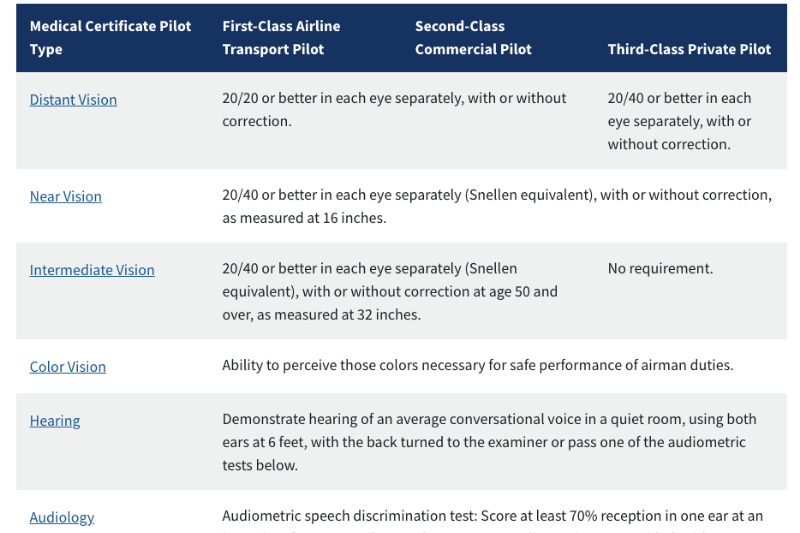
Vision requirements for a first-class certificate include distant vision of 20/20 or better in each eye, with or without corrective lenses, and near vision of 20/40 or better at 16 inches. Pilots 50 and older must also meet an intermediate vision standard of 20/40 at 32 inches. The first-class certificate is valid for 12 months for pilots under age 40 and 6 months for pilots 40 and older when exercising ATP privileges. After the first-class privileges expire, the certificate reverts to third-class privileges for the remainder of its valid period.
Class 2 Medical Certificate
A second-class medical certificate is required for pilots exercising commercial pilot certificate privileges, including flying passengers or cargo for hire. The vision standards for a second-class certificate are the same as for a first-class certificate, requiring 20/20 distant vision in each eye, with or without corrective lenses.
A second-class medical certificate is valid for 12 months for pilots under 40 and 12 months for pilots 40 and older when exercising commercial privileges. After those 12 months, it reverts to third-class validity for the remainder of its active period.
Class 3 Medical Certificate
A third-class medical certificate is the entry-level certification required for student pilots, recreational pilots, and private pilots who fly for personal use rather than compensation. The vision standard for a third-class certificate is less strict than the first and second class, requiring distant vision of 20/40 or better in each eye, with or without corrective lenses. There is no intermediate vision requirement for third-class applicants.
A third-class certificate is valid for 60 months for pilots under age 40 and 24 months for pilots 40 and older.
Pilot Medical Requirements
All three classes of medical certificates share a common set of baseline requirements in addition to the class-specific vision standards. Pilots must be able to hear an average conversational voice in a quiet room using both ears at a distance of 6 feet with their back turned to the examiner, or pass an audiometric speech discrimination test with a score of at least 70 percent in one ear.
The FAA also evaluates cardiovascular health, mental health history, neurological history, and general physical condition. Conditions that are considered disqualifying under 14 CFR Part 67 include a history of heart attack, cardiac valve replacement, permanent cardiac pacemaker, coronary heart disease that has required treatment, epilepsy, bipolar disorder, and substance dependence, among others. Some conditions may qualify for a Special Issuance, which allows a pilot to obtain a certificate after providing additional documentation and receiving approval from the Federal Air Surgeon.
Pilots are encouraged to obtain a medical certificate before investing significant time and money in flight training. A third-class exam typically costs under $150 and takes less than an hour. Discovering a disqualifying condition after completing flight training is a far more costly outcome. Knowing early on that you meet the medical standards allows you to move forward in your aviation career with confidence.