
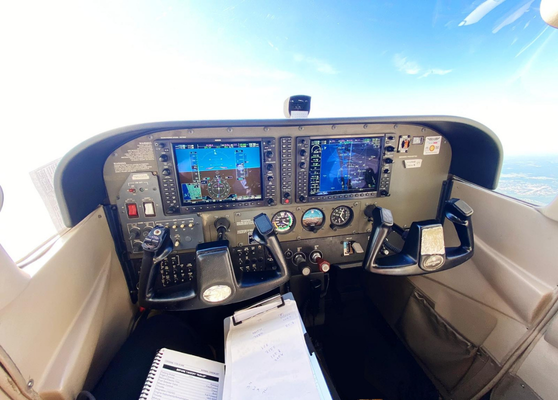
Instrument rating allows pilots to fly solely using cockpit instruments when there is low visibility in the sky. All commercial pilots will be required to obtain their instrument rating after completing their private pilot license (PPL), as it allows pilots to fly for hire under specific legal conditions. Beyond working for an airline, instrument rating is proof of a highly skilled pilot, one who is confident using their instruments instead of relying on clear skies outside their window.
Types of Instrument Ratings
First and foremost, commercial pilots must obtain their basic instrument rating (IR). Beyond that, pilots can train towards additional certifications. Each additional rating requires students to be tested before they can be certified.
Obtaining additional ratings ensures student pilots that they are not limited in their career once they complete their full flight training program. Some students leave flight school confident with what they want to do for a job. Others may start as a certified flight instructor to gain more experience before working for a major airline. Whatever the career trajectory is, having all the ratings ahead of time opens up all possibilities in a future career in aviation.
Certified Flight Instructor Instrument (CFII)
Pilots training to become a certified flight instructor must obtain the Certified Flight Instructor Instrument (CFII) that allows them to teach flight school students how to fly using cockpit instruments. The CFII allows certified flight instructors to conduct the required Instrument Proficiency Checks (IPCs) during training.
Additional Aircraft Multi-Engine Land Instrument (AARMELI)
The Additional Aircraft Multi-Engine Land Instrument (AARMELI) allows pilots to fly using their cockpit instruments in a multi-engine aircraft. For those interested in working for major airlines, this additional instrument rating is essential.
Benefits of Obtaining Instrument Ratings
Because instrument rating does not require pilots to be able to see out of their cockpit window, the FAA requires instrument ratings to fly in the following conditions:
- Instrument Meteorological Conditions (IMC): essentially, weather that prevents flying via ground reference
- Cloudy weather
- Instrument Flight Rules (IFR) flights
- Special airspace (Class A airspace)
- Flying for hire at night
An instrument rating serves as proof of a pilot’s exceptional skills relying on their instruments to confidently fly in low visibility. While there are some jobs a pilot can get without the instrument rating, such as corporate or charter aviation, the options are limited. In Superior Flight School’s F.A.R. Part 141 and F.A.R. Part 61 courses, instrument rating is built into the curriculum, allowing all pilots who obtain their CPL and ATP licenses to obtain their IR.
How Long Does It Take to Get an Instrument Rating?
The amount of time it takes to get an instrument rating depends on the type of program you are enrolled in, as each one requires a different level of flight hours, instrument rating training, and experience.
| Accelerated Program (Fast Track) | 2 months through the fast track flight training program |
| Part 141 Program | Requires 30 hours of training in the course for a basic instrument rating; 20 hours of training in courses for additional instrument ratings as stated in 14 CFR Appendix C to Part 141 |
| Part 61 Program | Requires 50 hours of cross-country time as a pilot-in-command (PIC) with at least 10 hours of flying; 40 hours of actual or simulated instrument flying with at least 15 hours from an authorized instructor that has their instrument rating; 3 hours of instrument flight training within 2 calendar months of the date of the test as stated in 14 CFR 61.65 |
Superior Flight School students can get through their IR flight training in 2-3 months through a standard track and 2 months through an accelerated training program.
Instrument Ratings for Commercial Pilots
All commercial pilots working for an airline are required by the FAA to obtain their instrument rating. Without it, pilots cannot carry out cross-country flights that exceed 50 nautical miles. They also cannot fly at night. This would limit their ability to do their job working for most airlines in the U.S., such as Delta Airlines or American Airlines.
Student pilots interested in obtaining their instrument rating are able to do so when enrolled in the Part 141 courses, Part 61 courses, or Accelerated Program.