
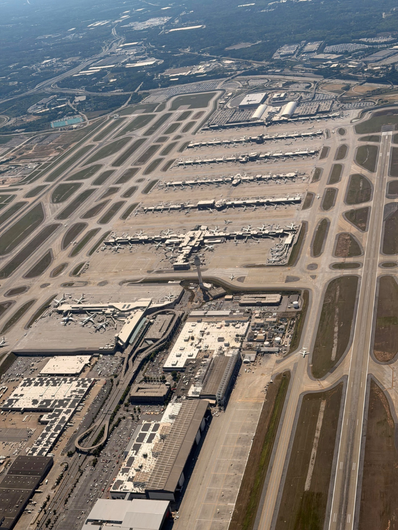
Hartsfield-Jackson Atlanta International Airport (ATL) is the busiest airport in the world for passenger traffic and has been for years. When determining where you should attend flight school, busy airspace makes a difference. Flight training within close proximity to ATL (but not flight training directly in Atlanta) allows students to gain experience in a complex, dynamic airspace that will best prepare them for what to expect as a commercial pilot.
What Is the World’s Busiest Airport?
In 1998, Hartsfield-Jackson Atlanta International Airport (ATL) was first named the busiest airport in the world with 73.5 million travelers. It has carried this title most years since then, with the exception only being 2020 because of the COVID-19 pandemic. In the airport with the most foot traffic, the airspace stays busy. Pilots who fly in and out of ATL need to be highly experienced in a busy airspace and have strong communication with air traffic controllers (ATC) during takeoff and landing.
For flight school students, this type of space can be overwhelming to train in. Instead of throwing students into the heart of Atlanta air traffic on their first discovery flight, Superior Flight School has the benefit of introducing students at Cobb County International Airport, just 21 miles northwest of Atlanta. This allows students to get comfortable in the cockpit first before progressing to a complex airspace.
What Makes ATL a Busy Airspace?
The ATL airspace is a Class B airspace, meaning it is a controlled airspace surrounding one of the busiest commercial airports. This type of airspace funnels high volumes of traffic in and out of the airport through strict ATC clearances.
Pilots operating near ATL need to maintain sharp situational awareness, communicate clearly and quickly, and understand exactly where they are and where they are not allowed to fly at all times. For student pilots, this environment makes a strong training ground to understand how to fly in one of the most complex types of airspace.
How Flight Training in a Busy Airspace Makes You a Better Pilot
Many flight school students in the U.S. only train in quiet and rural airspaces. That environment is ideal for perfecting basic maneuvers and introduces new students to their first experiences operating an aircraft. As training progresses, the need for experience in a busy airspace grows.
Proximity to a major Class B airspace like ATL, without being fully in the mix, gives student pilots the best of both worlds. After gaining experience operating an aircraft in an easy-to-manage airspace, ATL accelerates development in ways that calm skies cannot.
Hands-On Learning for ATC Communication
Radio communication with ATC is one of the pilot skills that shows a pilot’s confidence. In a low-traffic airspace, students may only hear a handful of transmissions per flight. When flying near Atlanta, student pilots gain exposure to heavy radio activity while being taught safe, effective tools to manage their workload.
Student pilots training near Atlanta learn the skill of active listening as a pilot. They are able to extract instructions from a continuous stream of ATC chatter without missing any important information. Students can also practice requesting flight following and coordinating transitions through a busy airspace. By the time students begin their careers working for an airline, they will have had plenty of experience communicating with ATC.
Situational Awareness
Flying near Atlanta requires all pilots to have situational awareness, a skill taught to all students in Part 141, Part 61, and accelerated programs. Situational awareness is better training through experience than through a written exam. Pilots need to be able to scan traffic constantly, interpret ATC communications, and maintain awareness of where others are (and where they are going) in a busy airspace. This skill is used in every aspect of flight, not just around busy airports.
Understanding Class B Airspace
All student pilots are required to understand what Class B airspace is before they can pass their FAA written exam and FAA Practical Exam. Beyond the written exam, students in flight training programs near Atlanta, Georgia get real-world experience training in Class B airspace. This gives students a competitive advantage over students who did not train near a busy airspace, giving them a skill that could help them stand out to airlines during the hiring process.
Why Training Near (Not In) Busy Airspace Makes a Difference
While training near a busy Class B airspace is ideal, students training just outside of these busy airports are positioned even better. They are close enough to absorb the complexity of the surrounding environment while first training in a setting appropriate and safe for even the newest student pilots.
Cobb County International Airport (KRYY) in Marietta, Georgia is an ideal flight training location for students who just obtained their student pilot certificate. This location provides students with real-world experience operating an aircraft near a major hub while flying in and out of a manageable, flight training-friendly airport. Students are able to build skills progressively and gain exposure to ATL’s busy airspace when they are ready, not when it is still overwhelming.
Start Your Flight Training Near Atlanta, Georgia
If you are serious about becoming a highly experienced and capable pilot, there is no better location to train than at Superior Flight School, located at KRYY. Whether you are just starting your flight training for the first time or are looking to transfer to a new flight school, training near Atlanta provides students with the best opportunities to hone their skills as a pilot.